This guide is based on published Japanese regulatory and industry information. It does not translate or assess the safety of every individual formula. This article may contain affiliate links; commissions do not affect our editorial conclusions.
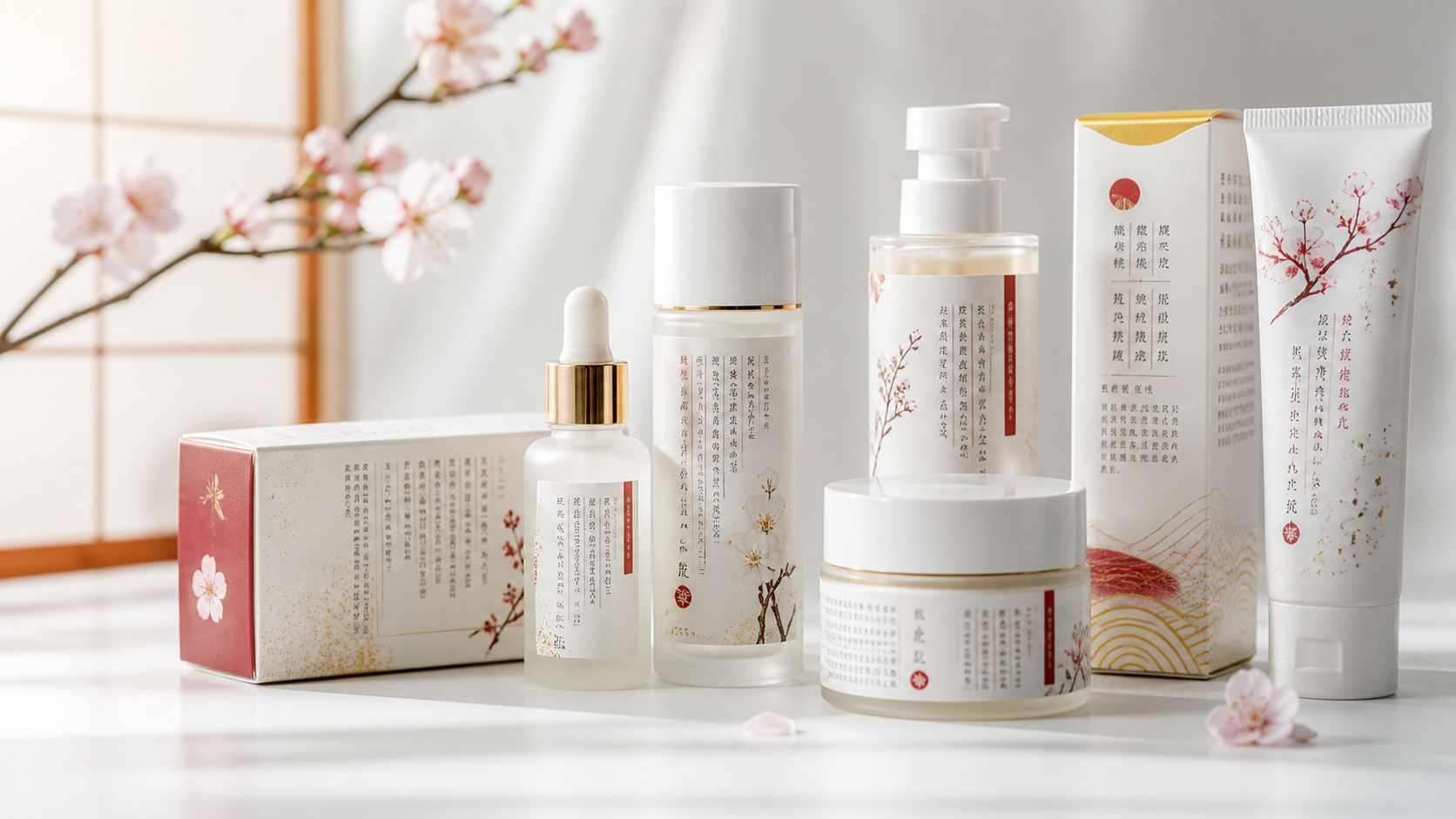
A Japanese skincare package can be information-dense even when the front looks minimal. The useful details are often on the back or bottom: the exact sales name, net content, ingredient list, directions, cautions, and the company responsible for marketing the product in Japan.
You do not need to translate every character before buying. Start with the fields that can change your decision.
The Five-Minute Label Check
- Confirm the exact product name, version, shade, and size.
- Look for
全成分(ingredients) and avoid guessing an English INCI name from appearance alone. - Read
使用方法(directions) and使用上の注意(cautions). - Check whether the package says
詰替えorつめかえ(refill). - Record the company, JAN barcode, and package details if regional versions or reformulations concern you.
For a deeper version check, use our guide to checking whether a Japanese beauty product is the current formula.
Start With the Front, Then Verify the Back
The front usually carries the consumer-facing product name and claims. Treat it as an introduction, not the complete record. Words such as “moist,” “bright,” or “medicated” may help identify the variant, but the back label provides the fields needed to distinguish closely related products.
On the back or bottom, look for the sales name (販売名), net content (内容量), directions, cautions, ingredient section, and company information. The prominent brand on the front may not be identical to the legal company named as the marketing authorization holder (製造販売元). That difference is not automatically suspicious.
Useful Japanese Label Terms
| Japanese | Practical meaning | What to verify |
|---|---|---|
| 全成分 | Ingredients | Use a reliable Japanese cosmetic-name reference; do not invent an INCI match. |
| 使用方法 | Directions | Amount, order, frequency, and whether the product is rinsed off. |
| 使用上の注意 | Cautions | Eye contact, broken skin, irritation, storage, and discontinuation guidance. |
| 内容量 | Net content | Compare mL with mL and g with g; check whether you are looking at a refill. |
| 販売名 | Sales or approved name | This may differ from the large name on the front. |
| 製造販売元 | Marketing authorization holder | The responsible company may differ from the consumer-facing brand. |
| 詰替え / つめかえ | Refill | Match the exact line, version, and capacity before buying. |
| 無香料 | No added fragrance / fragrance-free claim | It does not promise that the raw materials have no odor. |
| 医薬部外品 / 薬用 | Quasi-drug / medicated | It is not the same category as a prescription medicine. |
How to Approach the Ingredient List
Japan requires full ingredient labeling for cosmetics, a requirement introduced in April 2001, according to the Japan Cosmetic Industry Association (JCIA). JCIA also manages Japanese labeling names for cosmetic ingredients that have obtained, or are applying to obtain, an INCI name.
That system is why a Japanese ingredient list should not be treated as badly formatted English INCI. A translation app can help you locate the section, but a character-by-character translation may produce a familiar-sounding name that is not the correct standardized INCI term.
For a purchase decision, use the ingredient list in three stages:
- Confirm that you have the correct product and version.
- Search a trusted Japanese labeling-name database or the manufacturer’s official information.
- If a known allergy or previous reaction is involved, ask a qualified professional rather than relying on an automated translation.
An ingredient list alone also does not tell you the concentration of most ingredients, how the formula feels, or whether it will suit your skin.
Read Directions and Cautions Before Claims
JCIA explains that cosmetics and quasi-drugs must carry necessary directions and precautions on package inserts, containers, or packaging. These sections can matter more than the marketing headline.
Check whether the product is intended for the face, body, eye area, scalp, or hair; whether it is leave-on or rinse-off; and whether the manufacturer tells users to stop if irritation occurs. If you have persistent redness, swelling, pain, or another medical concern, seek professional advice instead of trying to solve it through label interpretation.
Three Labels That Commonly Change the Purchase
薬用 or 医薬部外品
These identify Japan’s quasi-drug category in the relevant context. They do not mean “prescription strength,” and they do not justify expanding the product’s official claims into medical promises.
詰替え or つめかえ
A refill pouch may resemble a lower-priced full product in a small listing image. Confirm the compatible bottle, product line, version, and capacity. A similar brand name is not enough.
無香料
Read this as a fragrance-related claim, not a guarantee of zero smell. Ingredients can have their own odor. If fragrance sensitivity matters, check the full ingredient information and the manufacturer’s current claim.
Warning Signs When Shopping Online
- The seller shows only the front and hides the back label.
- The title, package image, shade, or capacity do not agree.
- A refill is described as a complete bottle.
- The listing translates
薬用into a medical treatment claim. - The ingredient list has no source or appears copied from a different regional version.
- A discontinued package is presented as the current formula without a verification date.
None of these proves that a product is counterfeit, but each is a reason to pause and verify before paying.
Frequently Asked Questions
Is 薬用 the same as prescription medicine? No. In Japanese beauty labeling it commonly indicates the quasi-drug or medicated category, not a prescription medicine. Evaluate only the approved product claims.
Does 無香料 mean completely odorless? Not necessarily. It does not mean that every raw material is odorless.
Can I translate the Japanese ingredient list directly into INCI? Do not assume a literal translation is the standardized INCI name. Use manufacturer information or a recognized labeling-name reference.
How do I identify a refill? Look for 詰替え or つめかえ, then verify the compatible product, version, and amount.
Sources and limits
This guide uses JCIA ingredient-labeling guidance, JCIA Japanese labeling-name information, and JCIA post-marketing safety and precaution guidance. We did not visit a store, examine a specific package, or conduct a product test for this article. Layouts and terminology can vary, so check the current manufacturer’s information before purchasing. Last checked August 20, 2026.
Comments