This is a category guide, not a review of one specific Western toner. It uses published brand information and dermatology reporting to explain how the terms are commonly used. Some links may be affiliate links; commissions do not affect what is included.
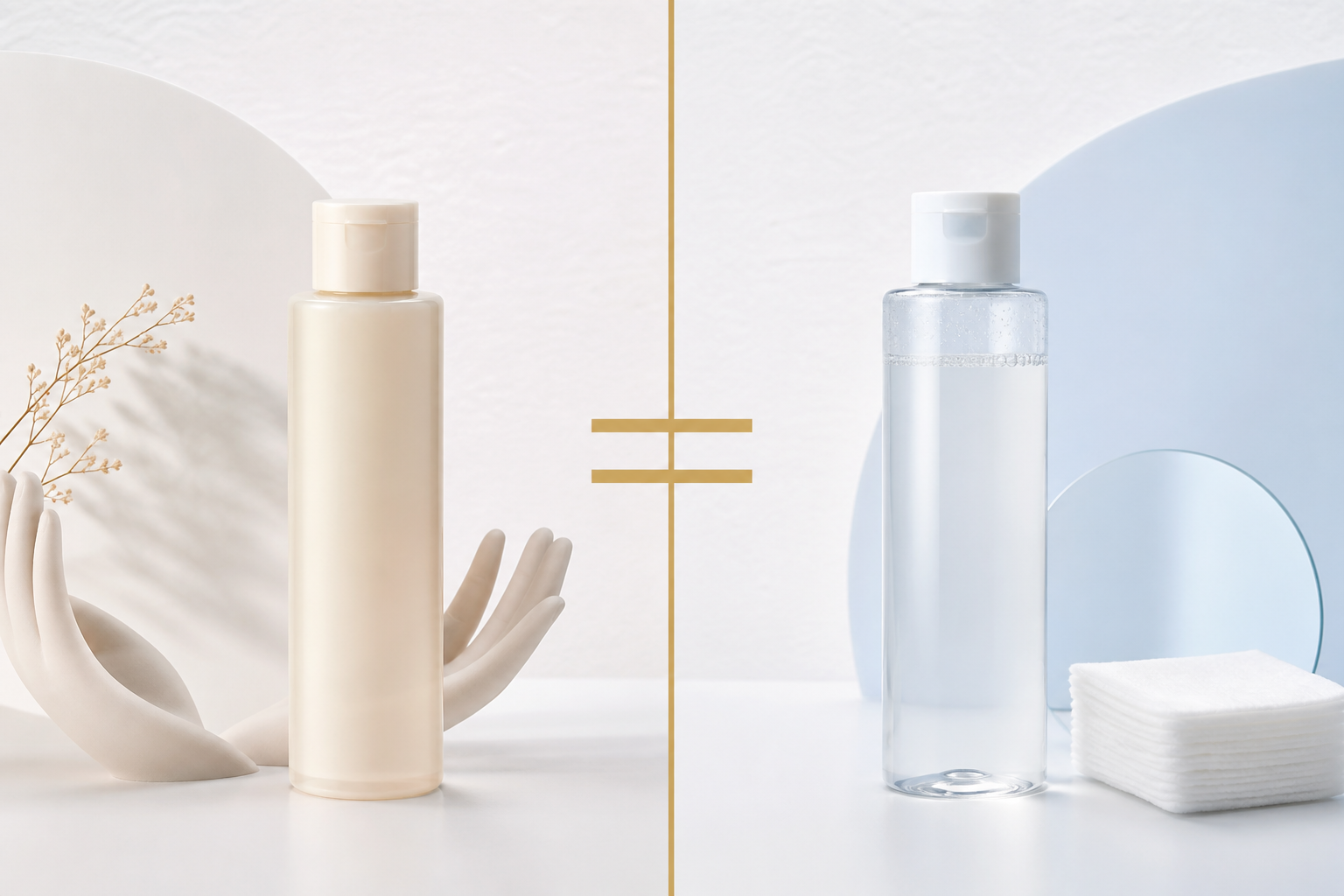
If you’ve spent any time reading about Japanese skincare, you’ve probably seen “lotion” used to describe a liquid step that sounds a lot like a toner but gets talked about very differently, less about wiping away residue, more about soaking your skin in hydration. So is it just a translation quirk, or is there a real difference? A bit of both, and it depends on which “toner” you’re comparing it to.
- Same Step, Different Philosophy
- What “Toner” Has Meant in Western Skincare (It’s More Than One Thing)
- What Japanese Lotion Is Built to Do
- At a Glance
- Three Japanese Lotions, as a Concrete Example
- Who Might Prefer Which — and Who Should Check Carefully
- Can You Use Both?
- Our Verdict
- Frequently Asked Questions
- Sources and limits
Same Step, Different Philosophy
Both a Western toner and a Japanese lotion (化粧水) are typically applied right after cleansing, before serums and moisturizer. That’s where the similarity is most reliable. What differs is the primary job each one is usually built to do, and that’s shaped by two different skincare traditions that developed somewhat separately.
What “Toner” Has Meant in Western Skincare (It’s More Than One Thing)
According to a dermatology industry publication’s overview of the category, toner in Western skincare spent most of the 20th century meaning a high-alcohol, witch-hazel, or acid-based liquid designed to strip away whatever a cleanser missed, an astringent, essentially. That style of toner still exists today, often aimed at oily or acne-prone skin, and typically lists alcohol, salicylic acid, or witch hazel among its main ingredients.
But the same source notes that toner has diversified significantly. Hydrating toners built around glycerin, hyaluronic acid, or ceramides are now common, aimed at dry or dehydrated skin rather than oil control. So “Western toner” isn’t one thing, it’s a category that spans from astringent to essentially hydrating, and which one a specific product is depends entirely on its ingredient list, not on the word “toner” on the label.
What Japanese Lotion Is Built to Do
Japanese lotion generally sits toward the hydrating end of that spectrum, and it’s usually the default rather than a specialty option. Several J-beauty retailers describe the category’s primary goal as delivering water and supporting the skin barrier immediately after cleansing, applied generously, sometimes in multiple thin layers, rather than swiped on lightly with a cotton pad. Because these sources are also sellers of Japanese skincare, we’re treating this as their framing of the category rather than a neutral, independent assessment, but it lines up with what we’ve found researching individual Japanese lotions: Hada Labo’s, Kikumasamune’s, and Naturie’s lotions are all built around humectant or water-retaining ingredients (hyaluronic acid, fermented rice liquid, hatomugi extract) rather than astringents.
At a Glance
| Typical Western Toner (astringent-style) | Typical Western Toner (hydrating-style) | Typical Japanese Lotion | |
|---|---|---|---|
| Primary goal | Remove residue, control oil | Add hydration, gentle prep step | Add hydration, prep skin for absorption |
| Common ingredients | Alcohol, witch hazel, salicylic acid | Glycerin, hyaluronic acid, ceramides | Hyaluronic acid, fermented ingredients, plant extracts, humectants |
| Alcohol, generally | Often present | Often alcohol-free | Often alcohol-free, though not universally (check each product) |
| Typical application | Light swipe with a cotton pad | Light to moderate application | Generous application, sometimes multiple layers |
This table describes general category tendencies based on the sources above, not a guarantee about any specific product; always check a given product’s own ingredient list.
Three Japanese Lotions, as a Concrete Example
To make this less abstract: Hada Labo’s Gokujyun Premium Lotion is built around eight types of hyaluronic acid and is alcohol-free, per the brand. Kikumasamune’s Sake Skin Care Lotion is built around fermented rice liquid. Naturie’s Hatomugi Skin Conditioner is built around Job’s tears extract. All three are covered in more depth in Best Japanese Lotions for Dehydrated Skin, and none of the three is marketed as an astringent or oil-control product, which is fairly representative of where most well-known Japanese lotions sit on the spectrum described above.
Who Might Prefer Which — and Who Should Check Carefully
If your main concern is dehydration, tightness, or a dull, water-starved feeling, a hydration-focused product, whether it’s labeled a Japanese lotion or a Western hydrating toner, is more likely to address that than an astringent-style toner. If your main concern is excess oil or breakouts and you specifically want an ingredient like salicylic acid, an astringent-style Western toner is doing a different job that a typical Japanese lotion isn’t built for.
Readers with alcohol-sensitive or reactive skin should check the specific ingredient list either way; “Japanese lotion” as a category leans alcohol-free, but that’s not a guarantee for every product, and some Western hydrating toners are alcohol-free too. The category label alone doesn’t tell you everything.
Can You Use Both?
There’s no rule against it, and plenty of routines combine steps. If you use an astringent-style toner for oil control after cleansing, a hydrating Japanese lotion afterward isn’t redundant, they’re doing different jobs. We don’t have testing data on every possible combination, so if you’re combining active ingredients (like a salicylic-acid toner) with a new product, patch-testing the combination is a reasonable precaution, and a dermatologist can advise on compatibility for your specific skin.
Our Verdict
- Try a Japanese lotion if your main goal is hydration and you want a generously-applied, humectant-forward step, regardless of what your current toner is called.
- Stick with an astringent-style Western toner if oil control or exfoliation is your actual goal; that’s a different job than most Japanese lotions are built for.
- Check the ingredient list either way if you have alcohol sensitivity or reactive skin, since the category name alone doesn’t guarantee a formula.
- Consider using both if you have different concerns at different times (for example, oil control on one area, hydration overall), rather than assuming they’re interchangeable.
Frequently Asked Questions
Is Japanese lotion just a fancy name for toner?
Not exactly. It’s applied at the same step in a routine, but it’s generally built and used for hydration rather than residue removal or oil control, which is closer to what a “hydrating toner” does in Western skincare than what a classic astringent toner does.
Are all Western toners astringent?
No, and that’s a common oversimplification. Astringent, alcohol-based toner was the historical default for most of the 20th century, per a dermatology trade publication, but hydrating toners built around glycerin, hyaluronic acid, or ceramides are common today too.
Which is better for dry or dehydrated skin?
Based on typical formulation, a hydrating product, whether a Japanese lotion or a Western hydrating toner, is generally a better fit than an astringent-style toner for dehydration. We don’t have head-to-head clinical data comparing the two hydrating categories directly.
Can I replace my toner with a Japanese lotion?
If your toner is astringent-style and your goal is oil control, replacing it changes what that step is doing for your skin, so consider whether you still need that function elsewhere in your routine. If your toner is already hydration-focused, switching to a Japanese lotion is more likely to be a like-for-like swap.
Sources and limits
Japanese lotion examples were checked against official Rohto Hada Labo, Kikumasamune, and Imju Naturie information. The discussion of toner history and types also draws on Dermatology Times. Toner is a broad category, so the guide does not assume that every Western toner is astringent. Last checked August 13, 2026.
Comments