This article contains affiliate links. If you purchase through one of these links, we may earn a commission at no extra cost to you. This does not affect which products we choose to compare or how we evaluate them.
Article research summary
- Research basis: Published-source comparison; this article reuses verified product research and is not a hands-on test.
- Last verified: August 8, 2026
- Primary sources: Rohto official Hada Labo page, Rohto official online shop, Kikumasamune official online shop
- Additional sources: Japanese Taste retailer listing, Murasaki Cosmetics listing, @cosme Hada Labo page
Editorial note: The comparison is based on official product information and secondary retailer or review context. Conclusions are editorial comparisons of documented features, not results from a controlled or hands-on test. Details we could not independently confirm are labeled in the article. Read our Editorial Policy and How We Research.
Updated August 13, 2026: Research labels and source links were added; the article’s conclusions were not changed.
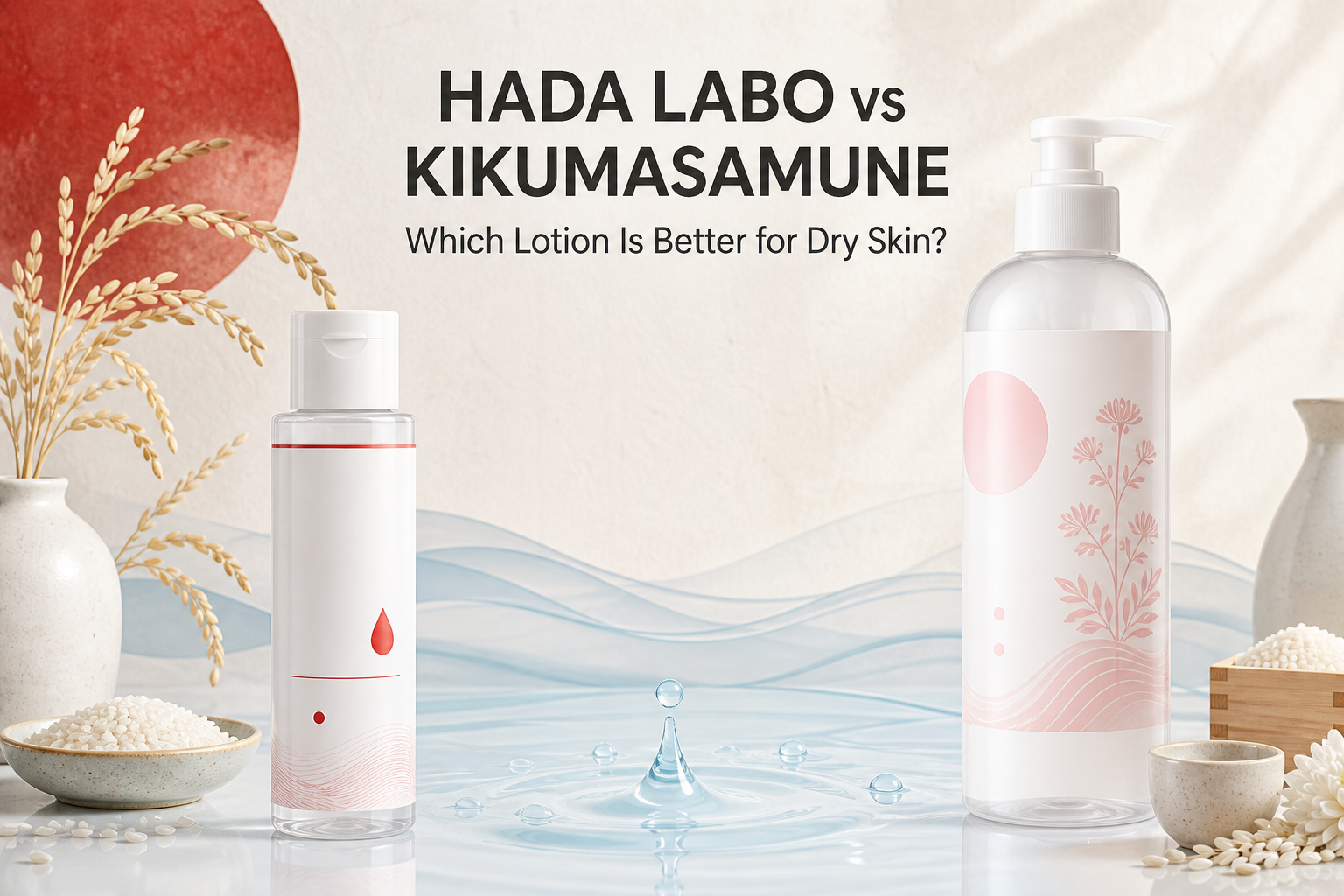
Both of these lotions have built loyal followings in Japan for very different reasons. Hada Labo’s Gokujyun Premium Lotion leans on a dense stack of hyaluronic acid types, while Kikumasamune’s High Moist lotion is built around a rice fermentation liquid drawn from the brand’s sake-brewing background. If you’re trying to decide between them, the honest answer is that they’re not solving the exact same problem, and which one fits you better depends on your skin’s needs, your budget, and how you like a lotion to feel going on.
At a Glance: Hada Labo Gokujyun Premium Lotion vs Kikumasamune Sake Skin Care Lotion High Moist
| Hada Labo Gokujyun Premium Lotion | Kikumasamune Sake Skin Care Lotion High Moist | |
|---|---|---|
| Brand | Hada Labo (Rohto Pharmaceutical) | Kikumasamune Sake Brewery |
| Core hydration approach | 8 types of hyaluronic acid, per the brand | Rice fermentation liquid (“sake” ingredient), ceramides, amino acids, per the brand |
| Size | 170 mL | 500 mL |
| Official Japan price | ¥1,100 (tax included) | ¥990 (tax included) |
| Approx. price per 100 mL | About ¥647 | About ¥198 |
| Texture, per official and reviewer descriptions | Thick, described by the brand and several individual reviewers as serum-like | Standard watery lotion consistency; some reviewers describe it as slightly sticky |
| Fragrance and alcohol | Fragrance-free and alcohol-free, per the brand | Contains fragrance, per the ingredient list; alcohol content not confirmed |
| SPF | None (not a sunscreen) | None (not a sunscreen) |
| Multi-use options | Face lotion, used as step one before moisturizer | Face and body lotion; can also be used as a roughly five-minute cotton-pad face mask, per the brand |
| Availability outside Japan | Sold through several US and international retailers | Not confirmed; we found no evidence of international retail during this research |
Prices and per-100 mL estimates are based on official Japan retail prices as of 2026-08-08 and are simple calculations from list price, not accounting for shipping, sales, or regional pricing.
Key Differences
The biggest difference between these two lotions isn’t price, it’s philosophy. Hada Labo’s Premium lotion is a hyaluronic acid concentrate: the brand markets it as containing eight different forms of hyaluronic acid, its highest count in the Hada Labo line according to the brand’s own product page. Kikumasamune’s lotion instead centers on a rice fermentation liquid, the “sake” ingredient the brand is named for, combined with ceramides, amino acids, and a handful of additional ingredients including placenta extract and arbutin. In other words, one is a hyaluronic acid-forward formula and the other is a fermentation- and ceramide-forward one; readers who specifically want to avoid or seek out either category should check the ingredient lists in the research behind this article rather than assume the two are interchangeable.
Size and price also diverge sharply. The Hada Labo bottle is smaller (170 mL) and costs more per 100 mL than the much larger 500 mL Kikumasamune bottle. If cost-per-use matters to you, Kikumasamune has a clear advantage on paper, though that doesn’t account for how much product each lotion’s texture requires per application, which we were not able to independently measure.
Texture and Feel: What We Could Confirm
We have not tested either product ourselves, so what follows is based on the brand’s own descriptions and patterns across multiple individual reviewers, not our own hands-on impressions.
Hada Labo’s Gokujyun Premium Lotion is consistently described, by the brand and by several English-language bloggers, as noticeably thicker than a typical toner, closer to a gel or a light serum than a watery lotion. The brand’s own marketing describes it as “rich yet smoothly absorbed.” Kikumasamune’s High Moist lotion, by contrast, reads as a more conventional watery lotion in the sources we reviewed, and a portion of the aggregate reviews on a major Japanese review platform mention a somewhat sticky finish.
If you tend to find thick, serum-like lotions uncomfortable in humid climates or warmer months, that’s a texture-level distinction worth weighing. If you specifically want the “layer it on like a mask” feel, Hada Labo’s thicker consistency may appeal more directly.
Ingredients to Know
Hada Labo’s Premium formula is built around its eight hyaluronic acid types (including sodium hyaluronate, acetylated sodium hyaluronate, and several other hyaluronic acid derivatives), and the brand states the full lotion is fragrance-free, alcohol-free, colorant-free, and paraben-free. We confirmed this ingredient list directly on Rohto’s official online shop.
Kikumasamune’s lotion leads with its rice fermentation liquid, followed by glycerin and BG as base moisturizers, two ceramide types (ceramide 3 and ceramide 6-II), amino acids including glutamic acid and arginine, placenta extract, arbutin, dipotassium glycyrrhizate, and soy protein, with fragrance listed further down the ingredient panel. Some readers may want to research placenta extract and arbutin further or avoid them based on personal preference; we did not find detailed sourcing or safety data for either on the brand’s own pages.
Neither brand’s site, in the pages we reviewed, states ingredient concentrations, so we can’t compare potency directly, only which ingredients are present.
Official How-to-Use Instructions
According to Rohto’s official brand page, Hada Labo’s Gokujyun Premium Lotion is meant to be the first step in a three-step routine (lotion, then a milk or cream), applied after cleansing. The specific application method, such as whether to use your palms or a cotton pad, and how much product to use per application, wasn’t specified on the official pages we checked, so we’re treating that detail as not verified.
Kikumasamune’s official retailer describes applying an appropriate amount by hand, and separately suggests soaking a cotton pad or tissue and leaving it on skin for about five minutes as an occasional mask treatment, in addition to using it as a regular lotion on the face and body.
Who Each Lotion May Suit
Hada Labo Gokujyun Premium Lotion Is Likely a Good Fit If…
You have dry to very dry skin and want a single, hyaluronic acid-concentrated step that feels closer to a serum than a splash-on toner. It may also suit readers who prioritize a fragrance-free, alcohol-free formula, since those claims are stated directly on the brand’s own product page. The 170 mL bottle may also appeal if you prefer buying a smaller quantity at one time than Kikumasamune’s 500 mL bottle.
Kikumasamune Sake Skin Care Lotion High Moist Is Likely a Good Fit If…
You want a large-volume, everyday lotion for both face and body, are curious about fermentation-based Japanese skincare, and don’t mind a formula that includes fragrance. The occasional five-minute cotton-mask use case, confirmed on the brand’s own retailer page, is a nice bonus if you like adding a mask step without buying a separate product. Readers who prefer to avoid placenta extract or arbutin should review Kikumasamune’s full ingredient list before choosing it.
Price, Size, and Buying Notes
Hada Labo’s Gokujyun Premium Lotion is listed at ¥1,100 (tax included) for 170 mL on Rohto’s official Japanese online shop, and it’s also sold through a number of US and international retailers. As of 2026-08-08, we found it listed at $11.99 (sale price; $14.99 regular price) at japanesetaste.com, and at €20.95 at murasakicosmetics.com; neither of these international listings is Rohto’s own official storefront, so we’d treat them as third-party retail pricing that can vary.
Kikumasamune’s High Moist lotion is listed at ¥990 (tax included) for 500 mL on the brand’s official online shop. We did not find confirmed international availability or pricing for this product during our research, so if you’re outside Japan, we’d recommend checking with an international retailer directly rather than assuming it ships to your region.
Because the two products differ so much in size (170 mL vs. 500 mL), we’d suggest comparing them on a per-100 mL basis rather than sticker price alone: roughly ¥647 per 100 mL for Hada Labo versus roughly ¥198 per 100 mL for Kikumasamune, based on official Japan list prices as of 2026-08-08.
Our Verdict
These two lotions aren’t really competing for the same reader. Hada Labo’s Gokujyun Premium Lotion is a concentrated, hyaluronic acid-forward option in a smaller bottle, with a texture that leans thick and serum-like and a clearly stated fragrance-free, alcohol-free formula. Kikumasamune’s High Moist lotion is a larger-volume, lower-cost-per-use option built around a fermentation ingredient and ceramides, with a more conventional watery texture and the flexibility to double as an occasional face mask. If your priority is a rich, hyaluronic acid-concentrated single step, Hada Labo is the more direct match. If you want a large everyday bottle for face and body at a lower cost per use, and you’re curious about fermentation-based skincare, Kikumasamune is the more practical pick. We were not able to independently test either product’s actual moisturizing performance, so both should be treated as reasonable options to try rather than guaranteed solutions for dry skin.
Frequently Asked Questions
Which one is more moisturizing for very dry skin?
We can’t say definitively, since we did not independently test either product. Hada Labo’s thicker, hyaluronic acid-concentrated texture is often described by reviewers as feeling more intensive, while Kikumasamune’s formula adds ceramides and amino acids to its fermentation base, per the brand’s own ingredient list. Both have generally positive aggregate review data on a major Japanese review platform, and individual results are likely to vary.
Does either lotion contain alcohol or added fragrance?
Hada Labo’s Gokujyun Premium Lotion is stated by the brand to be fragrance-free and alcohol-free. Kikumasamune’s High Moist lotion lists fragrance in its ingredient panel; we were not able to confirm its alcohol status from the sources we reviewed.
Can I use both products together in the same routine?
We didn’t find brand guidance addressing this specific combination, and this isn’t medical advice. In general, layering two lotions with different textures is common in Japanese skincare routines, but if you have sensitive or reactive skin, we’d suggest patch testing any new combination first and consulting a dermatologist if you have concerns.
Which one is more affordable per use?
Based on official Japan list prices as of 2026-08-08, Kikumasamune works out to roughly ¥198 per 100 mL, compared to roughly ¥647 per 100 mL for Hada Labo. This is a simple price-to-volume calculation and doesn’t account for how much product each texture requires per application.
Is either lotion available outside Japan?
Hada Labo’s Gokujyun Premium Lotion is sold through several US and international retailers, based on our research, though we did not find an official Rohto storefront outside Japan. We were not able to confirm any international availability for Kikumasamune’s High Moist lotion during this research; readers outside Japan should check with international retailers directly.
Sources
- Rohto official Hada Labo page — source used for product information or editorial context (verified August 8, 2026).
- Rohto official online shop — source used for product information or editorial context (verified August 8, 2026).
- Kikumasamune official online shop — source used for product information or editorial context (verified August 8, 2026).
- Japanese Taste retailer listing — source used for product information or editorial context (verified August 8, 2026).
- Murasaki Cosmetics listing — source used for product information or editorial context (verified August 8, 2026).
- @cosme Hada Labo page — source used for product information or editorial context (verified August 8, 2026).
Comments